What is an online safety management system?

An online safety management system is a cloud-based platform that lets businesses manage health and safety processes – including risk assessments, incident reporting, audits and compliance – in one place. It replaces paper-based systems and disconnected spreadsheets with a centralised digital record that is accessible from any device.
For UK businesses operating across multiple sites, managing contractors or running high-risk activities, an online system is increasingly the standard rather than the exception. This article explains what such a system should include, how it differs from traditional approaches and what to consider when choosing one.
What should an online safety management system include?
The core capability of an online safety management system covers the full cycle of health and safety activity: identify hazards, assess risks, implement controls, monitor compliance and investigate incidents when they occur. In practice, the key functional areas are:
- Risk assessment management – create, assign, review and version-control risk assessments, with digital signatures and evidence capture
- Incident reporting – log accidents, near misses and hazards in real time via mobile, with RIDDOR-relevant data capture
- Audit and inspection management – schedule, carry out and track corrective actions from H&S audits and site inspections
- Permit to work – issue, approve and close out high-risk work permits electronically, with a full audit trail
- COSHH and chemical management – record hazardous substances and ensure relevant control measures are documented
- Contractor management – onboard, induct and monitor third-party contractors in a single workflow
- Training and inductions – track worker competencies, certifications and induction completion
- Lone worker monitoring – check-in functionality for workers operating in isolation
Not every organisation needs all of these modules from day one. The advantage of a modular online system is that businesses can start with their most pressing compliance gaps and expand coverage over time.
How does an online system differ from a spreadsheet or paper-based approach?
| Capability | Paper / spreadsheet | Online safety management system |
|---|---|---|
| Real-time data capture | Not possible – forms completed after the fact | Workers log incidents and inspections as they happen |
| Accessibility | Physical location dependent | Available on any device, anywhere |
| Audit trail | Easily lost, altered or incomplete | Timestamped, tamper-evident digital records |
| Corrective action tracking | Manual follow-up required | Actions assigned, tracked and escalated automatically |
| Regulatory reporting | Manual compilation | Data structured for RIDDOR and compliance reporting |
| Cross-site visibility | Siloed by location | Unified view across all sites and teams |
The difference in audit outcomes is significant. When an enforcement body or ISO auditor requests evidence of risk assessment reviews, incident investigations or training records, an online system can produce a complete, timestamped record immediately. Organisations relying on paper files or shared drives face a manual retrieval exercise that is both time-consuming and incomplete by default.
What is safety management software?
Safety management software is the software category that online safety management systems belong to. The terms are used interchangeably, though ‘online safety management system’ tends to emphasise the cloud-based, always-accessible nature of modern platforms, while ‘safety management software’ is more general and may include legacy installed software.
Related terms include EHS software (Environment, Health and Safety software), HSE software and health and safety management software. These all describe broadly the same category: a digital platform for managing an organisation’s health and safety obligations.
What is a health and safety management system?
A health and safety management system (HSMS) is the organisational framework – policies, procedures, processes and records – that an employer uses to manage health and safety risk. An online safety management system is the technology that implements and supports that framework.
ISO 45001:2018 is the international standard for occupational health and safety management systems. It sets out the requirements for a systematic approach to managing H&S risk, including hazard identification, risk assessment, legal compliance, incident investigation and continual improvement. An effective online safety management system should support ISO 45001 compliance by providing the documented evidence and workflow tools the standard requires.
Key buying criteria for an online safety management system
- Mobile-first design – field workers need to be able to complete risk assessments, log incidents and confirm permits from a smartphone. A platform that requires a desktop is a bottleneck.
- Configurability – pre-built templates accelerate deployment, but the system must also allow custom forms, workflows and approval chains that reflect how your organisation actually operates.
- Audit trail integrity – every change to a record should be logged with a timestamp and user ID. This is non-negotiable for regulatory and legal purposes.
- Integration with existing systems – HR systems, contractor management portals and document management platforms are common integration points. Check what APIs or native integrations are available.
- Scalability – a system that works for 50 users should also work for 500. Pricing and performance at scale are both worth testing.
- Vendor support and implementation – for organisations without dedicated H&S IT resource, the vendor’s onboarding support and ongoing customer success function matter as much as the software itself.
How Work Wallet functions as an all-in-one online safety management system
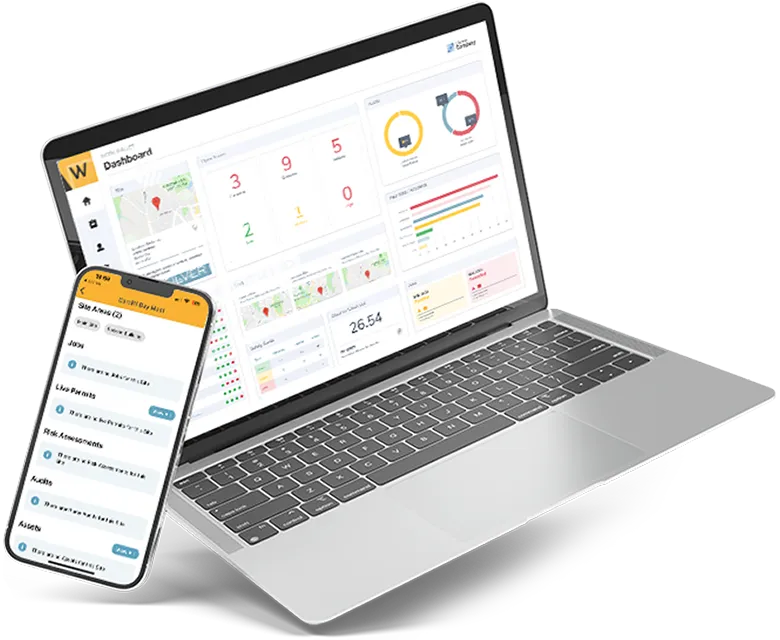
Work Wallet is built around the principle that health and safety management should happen at the point of work, not in a back-office system. The platform covers risk assessments, incident reporting, permits to work, audits, COSHH, contractor management, lone worker monitoring, RAMS and digital inductions from a single mobile and desktop application.
All modules share a common audit trail and reporting layer, which means that safety managers get a unified view of activity across sites and teams. Work Wallet is used by organisations in construction, facilities management, manufacturing, utilities and professional services.
Frequently asked questions about online safety management systems
What is an online safety management system?
An online safety management system is a cloud-based platform that centralises health and safety management – risk assessments, incident reporting, audits, permits, training records and more – in a single digital environment accessible from any device.
What is safety management software?
Safety management software is the broad software category covering platforms that help organisations plan, implement and monitor their health and safety processes. Online safety management systems, EHS software and HSE software all fall within this category.
What does a health and safety management system include?
A health and safety management system includes the policies, procedures, risk assessments, training records, audit findings and incident records that document how an organisation manages H&S risk. An online system adds the digital infrastructure to create, store and act on those records in real time.
Is an online safety management system a legal requirement in the UK?
No specific format is legally required. UK health and safety law (primarily the Health and Safety at Work etc. Act 1974 and associated regulations) requires employers to manage risk and keep certain records, but does not prescribe how. An online system is the most practical way to meet those requirements consistently and demonstrably.
Moving from reactive to systematic safety management
The shift from paper or spreadsheet-based health and safety to an online system is not primarily a technology decision – it is a decision about how seriously an organisation takes the consistency and defensibility of its safety management. Online systems do not make workplaces safe by themselves. What they do is create the conditions for systematic, evidence-based safety management: visible risk profiles, closed-loop incident investigation and a real-time record that stands up to scrutiny.
Get Started
Join the 10,000+ companies that grow with Work Wallet every day - trusted to simplify operations, boost safety, and keep teams connected.