What is EHS? Environment, health and safety explained

EHS (Environment, Health and Safety) is the framework organisations use to manage workplace safety, environmental impact, and regulatory compliance in an integrated way.
It brings together three disciplines that organisations traditionally managed separately: environmental management, occupational health, and occupational safety.
Understanding EHS is important because these areas increasingly overlap. For example, an industrial accident can affect both worker safety and the environment, while a chemical hazard may require both COSHH controls and environmental waste management procedures.
By managing these disciplines together, organisations can reduce duplication, improve accountability, and maintain a single, defensible record of their EHS performance.
What does EHS stand for?
HS stands for Environment, Health and Safety. Multinational organisations commonly use the term, particularly across the US, Europe, and other global markets.
In the UK, organisations often use HSE (Health, Safety and Environment) instead. Although the order differs, both terms refer to the same three disciplines.
A common source of confusion is the difference between EHS and the HSE. The Health and Safety Executive (HSE) is the UK regulator responsible for enforcing workplace health and safety laws. In contrast, EHS is the management framework organisations use to meet regulatory requirements and manage environmental, health, and safety risks.
What does EHS management involve?
EHS management covers a broad range of activities, but the core operational responsibilities fall into three areas:
Health and safety management
- Risk assessment and hazard identification
- Incident reporting, investigation and corrective action
- Permit to work and contractor management
- Training, competency management and inductions
- Audit and inspection programmes
- RIDDOR compliance (UK)
Environmental management
- Environmental impact assessment
- Waste and effluent management
- Air, water and land pollution control
- Environmental incident reporting
- ISO 14001 compliance management
Compliance and regulatory management
- Monitoring changes to relevant legislation (UK HSE, Environment Agency, sector-specific regulators)
- Maintaining documentation of regulatory obligations and compliance evidence
- Supporting regulatory inspections and audits
- Reporting to senior management and boards on EHS performance
How does it differ from HSE and ESG?
| Term | Meaning | Context |
|---|---|---|
| EHS | Environment, Health and Safety – the management framework organisations use to manage risk in all three areas | Used in corporate and operational contexts, especially multinational organisations |
| HSE | Health and Safety Executive – the UK government regulator for workplace health and safety | Regulatory and enforcement context; also used as shorthand for ‘health, safety and environment’ in some UK organisations |
| ESG | Environmental, Social and Governance – a broader framework for non-financial reporting used by investors and boards | Strategic and reporting context; EHS data often feeds into the E and S components of ESG reporting |
| EHS software | A digital platform for managing EHS processes – risk assessments, incident reporting, audits, compliance tracking | Technology context; Work Wallet is an example of EHS software |
What is EHS compliance?
EHS compliance is the state of meeting all applicable legal obligations across environment, health and safety. In a UK context, this includes compliance with the Health and Safety at Work etc. Act 1974, the Management of Health and Safety at Work Regulations 1999, RIDDOR, COSHH, the Environmental Protection Act 1990, the Environment Act 2021 and numerous sector-specific regulations.
Compliance is not a destination – it is an ongoing management process. Legislation changes, operations change and new hazards emerge. EHS compliance management involves continuously monitoring the regulatory landscape, assessing the organisation’s activities against current requirements and maintaining evidence that obligations are being met.
What is EHS software?
EHS software is a digital platform that supports the management of environment, health and safety processes in one place. Core functions typically include risk assessment management, incident reporting, audit and inspection management, permit to work, training and competency tracking and compliance reporting.
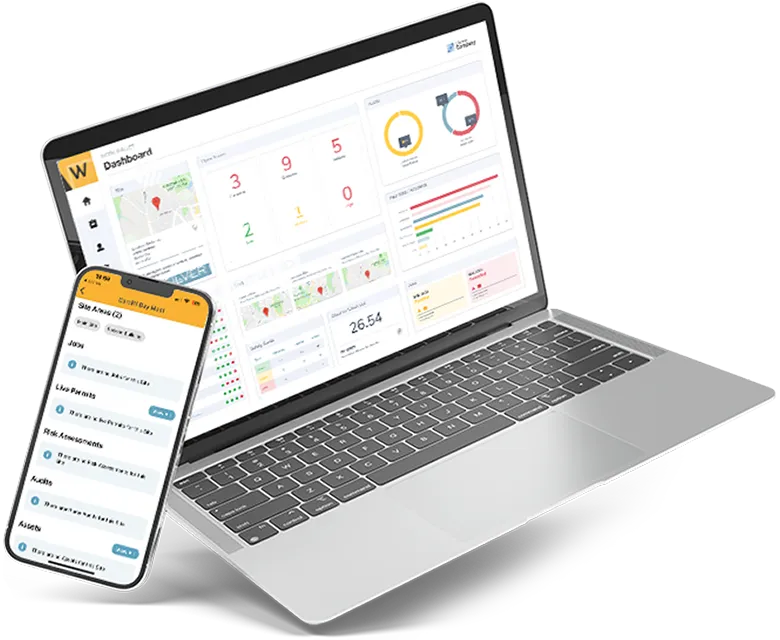
Work Wallet is an EHS software platform focused on health and safety management. It supports the core operational processes – Risk Assessments, Incident Reporting, Permit to Work System, Audits and Inspections, Contractor Management, Lone Worker Monitoring and Digital Inductions – from a single mobile and desktop application.
EHS software matters because manual, paper-based or spreadsheet-based approaches to compliance management are unreliable at scale. The larger the organisation, the more sites, activities and people involved, and the higher the risk of a compliance gap going undetected. A well-implemented EHS platform provides real-time visibility of compliance status across the organisation and creates the audit trail needed for regulatory and legal accountability.
An integrated discipline, not three separate functions
Organisations that manage EHS most effectively treat it as a single, integrated function rather than three separate disciplines.
For example, teams assess a chemical spill for both its safety risks and environmental impact at the same time. Likewise, training programmes cover health and safety competencies alongside environmental awareness, while a single audit programme reviews all three areas.
EHS software supports this approach by bringing risk assessments, incident reporting, compliance tracking, and environmental data into one system. As a result, organisations improve visibility, reduce duplication, and create a more consistent approach to managing risk. If you’re focused specifically on the health and safety side, our health and safety software covers those core processes in detail.
Get Started
Join the 10,000+ companies that grow with Work Wallet every day - trusted to simplify operations, boost safety, and keep teams connected.