What is safety management software?

Safety management software is a digital platform that helps businesses plan, manage, and monitor their health and safety processes. By replacing paper-based systems and spreadsheets, it creates a centralised, audit-ready environment for managing workplace safety.
The platform supports key activities such as risk assessments, real-time incident reporting, corrective action management, and compliance tracking, all within a single accessible system.
Safety management software forms part of the wider EHS (Environment, Health and Safety) software market. Organisations also refer to it as health and safety management software, HSE software, or online safety management systems. While the terminology varies, the core functionality remains largely the same.
What does safety management software do?
Safety management software operationalises the health and safety management cycle: identify hazards, assess risks, implement controls, monitor compliance and learn from incidents. The core capabilities that a well-built platform should provide are:
- Risk assessment management – create, version-control, review and sign off risk assessments with a complete digital audit trail
- Incident reporting and investigation – log accidents, near misses and dangerous occurrences in real time, with RIDDOR-relevant data capture and corrective action tracking
- Audit and inspection management – schedule, complete and track outcomes from H&S audits and site inspections using configurable checklists
- Permit to work – issue and manage work permits for high-risk activities, with electronic approval and close-out
- Training and competency management – maintain training records, track expiry dates and manage induction completion
- Contractor management – onboard and monitor third-party contractors, with document storage and site induction records
- Lone worker monitoring – check-in and alert functionality for workers in isolated environments
- Reporting and analytics – safety performance dashboards, trend analysis and compliance reporting for management and boards
Who uses safety management software?
Safety management software is used by organisations across a wide range of sectors and sizes, but adoption is highest in industries where:
- Workers are dispersed across multiple sites or operate in the field, making paper-based systems impractical
- High-risk activities (confined space, working at height, hot work, live electrical work) require permit to work controls
- Contractor populations are significant and require systematic onboarding and monitoring
- Regulatory scrutiny is high – HSE, Environment Agency, sector regulators or client audit programmes create a need for consistent, defensible records
Construction, utilities, facilities management, manufacturing, logistics and social care are among the sectors where safety management software has the most operational impact.
How digital systems improve safety outcomes
The link between software and safety outcomes is not automatic – it depends on adoption and process quality. Where organisations implement safety management software effectively, the improvements are typically:
- Faster incident reporting – mobile reporting at the point of an incident captures information before details are forgotten or scenes change, improving investigation quality
- Higher near-miss reporting rates – lower friction in reporting (no paper forms, no trip to the office) typically increases near-miss reporting, which is the leading indicator that organisations most commonly undercount
- Closed-loop corrective actions – software tracks corrective actions from assignment to close-out, eliminating the ‘action assigned but never completed’ failure mode common in manual systems
- Consistent risk assessment quality – templates and mandatory fields reduce variance between individual risk assessors, improving the baseline quality of assessments across the organisation
- Audit readiness – when an HSE inspector or ISO auditor requests evidence of compliance, the data is structured, searchable and timestamped. Manual systems require a document search exercise that is both time-consuming and typically incomplete
What is the difference between safety management software and a health and safety app?
The terms are often used interchangeably, but they describe different types of solutions.
- A health and safety app typically focuses on one or a small number of specific functions, such as risk assessments, incident reporting, or permits to work. It is usually mobile-based and may or may not include a desktop interface.
- In contrast, safety management software provides a more comprehensive platform. It brings together multiple health and safety functions, including risk assessments, incident reporting, audits, training records, and compliance management. It also includes reporting tools, management dashboards, and a complete audit trail across the entire health and safety lifecycle.
This distinction becomes important when organisations need connected data across different processes. For example, a standalone incident reporting app cannot automatically link incidents to relevant risk assessments, while a separate risk assessment tool cannot compare training records against incident data.
As a result, organisations often work with fragmented information and limited visibility. Integrated safety management software solves this problem by bringing all safety data into one system, creating a unified view of risks, incidents, training, and compliance activities.
How Work Wallet supports health and safety management
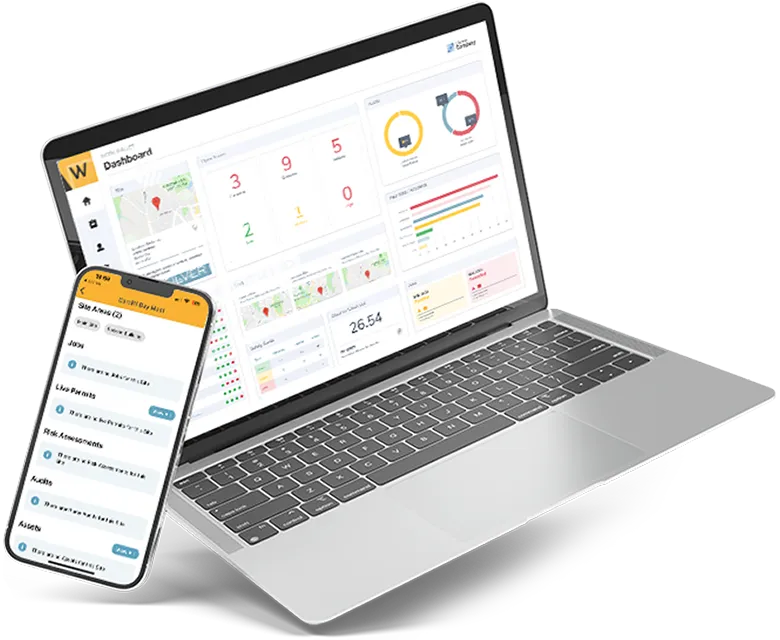
Work Wallet brings together the full range of health and safety management functions in a single platform. Teams can manage Risk Assessments, Incident Reporting, Permit to Work System, Audits and Inspections, Contractor Management, Lone Worker Monitoring and Digital Inductions from both mobile and desktop devices.
Because all modules share a common audit trail and reporting layer, organisations gain a consistent view of safety performance across their operations. Explore our health and safety software to see the full platform in detail.
Work Wallet is designed specifically for field-based industries, including construction, utilities, facilities management, and manufacturing. Workers can complete safety tasks directly at the point of work using the mobile app, while safety managers and directors use the desktop dashboard to monitor activity, compliance, and performance across multiple sites and teams.
Frequently asked questions
What is safety management software?
Safety management software is a digital platform that helps businesses manage health and safety processes – risk assessments, incident reporting, audits, permits, training records and compliance – in a single centralised system.
What does safety management software do?
Safety management software operationalises the full H&S management cycle: risk identification, assessment, control implementation, compliance monitoring and incident investigation. Core functions include risk assessment management, incident reporting, audit management, permit to work and training records.
How much does safety management software cost?
Pricing varies significantly by platform, scope of modules and organisation size. Most platforms use a subscription model priced per user per month or per site per year. For an accurate Work Wallet pricing estimate, the best approach is to contact the Work Wallet team directly for a quote based on your specific requirements and user numbers.
What is the difference between safety management software and EHS software?
EHS software (Environment, Health and Safety software) typically includes environmental management functions alongside health and safety. Safety management software may focus primarily on H&S without the environmental component. The distinction is not always clear-cut – some platforms use the terms interchangeably.
The right software does not manage safety – it makes it manageable
Safety management software helps organisations manage health and safety in a consistent and structured way. It simplifies reporting, improves corrective action tracking, and provides the evidence needed to demonstrate compliance and accountability.
However, technology alone does not improve safety. Organisations must train employees, embed the system into daily workflows, and use the data it generates to drive meaningful improvements.
When organisations combine effective processes with strong user adoption, they gain more than compliance. They reduce incidents, improve safety performance, and build a culture that demonstrates a genuine commitment to protecting people.
Get Started
Join the 10,000+ companies that grow with Work Wallet every day - trusted to simplify operations, boost safety, and keep teams connected.