What is a point of work risk assessment (POWRA)?

What is a point of work risk assessment (POWRA)?
A point of work risk assessment (POWRA) is a brief, on-the-spot safety check completed by workers immediately before starting a task, particularly in field-based or lone-working environments. Unlike a standard risk assessment – which is prepared in advance by a supervisor or safety professional – a POWRA is done by the worker, at the location, at the moment the work is about to begin.
The POWRA exists because conditions change. A risk assessment written for a task a week ago cannot account for the waterlogged ground, the missing barrier or the unexplained smell of gas that the worker encounters when they arrive on site. A POWRA bridges that gap.
How a POWRA differs from a standard risk assessment
| Dimension | Standard risk assessment | Point of work risk assessment (POWRA) |
|---|---|---|
| When completed | In advance, often days or weeks before the task | Immediately before the task begins, at the work location |
| Who completes it | Supervisor, safety professional or competent manager | The worker carrying out the task |
| Scope | Generic to the task type and environment | Specific to current, actual site conditions |
| Format | Detailed documented assessment, often multi-page | Brief structured checklist, typically one page or less |
| Purpose | Establish controls for a category of work | Verify conditions are as expected and flag new hazards |
The two are complementary, not alternatives. A POWRA does not replace the background risk assessment for a task – it supplements it with real-time, on-the-ground verification.
When do you need a point of work risk assessment?
A POWRA is most commonly required in:
- Lone working environments – workers operating without direct supervision need a mechanism to assess their own safety before starting work. A POWRA provides that structured check.
- Field-based and mobile working – utility workers, engineers, inspectors and contractors working across multiple sites face conditions that vary from visit to visit
- Construction and maintenance tasks – particularly for high-risk activities where site conditions change frequently
- Facilities management – reactive maintenance tasks that cannot be fully pre-planned
- Any task where site conditions are not fully predictable in advance
Some industries and employers mandate a POWRA for all field tasks. Others require one only for tasks above a defined risk threshold. The trigger should be based on the organisation’s risk assessment of its own activities.
How to complete a POWRA
A POWRA is designed to be quick – typically no more than five to ten minutes – but it must be genuine, not a tick-box exercise. The standard POWRA process covers four steps:
- Stop – pause before starting work and create the mental space to assess the situation rather than proceeding on autopilot
- Look – survey the work area for hazards not identified in the background risk assessment: unexpected people nearby, environmental conditions, equipment condition, access and egress
- Assess – consider the likelihood and consequence of identified hazards. Can the work proceed safely with existing controls in place? Are additional controls needed?
- Manage – apply the appropriate controls, adjust the work plan if needed, or stop and seek guidance if the conditions cannot be made safe. Record the outcome.
This four-step model – Stop, Look, Assess, Manage (SLAM) – is used by many organisations as the structural basis of their POWRA process.
What a POWRA template should include
A POWRA form should be short enough to complete in the field and structured enough to prompt genuine assessment. A standard template covers the following elements:
- Worker name and date
- Task description and location
- Reference to the applicable background risk assessment
- Checklist of specific hazard categories to consider (e.g. access, overhead hazards, ground conditions, lone working, weather, equipment, third parties)
- Space to note any new or unexpected hazards identified
- Controls applied or additional controls needed
- Decision: proceed / modify and proceed / stop and escalate
- Worker signature confirming the assessment was completed
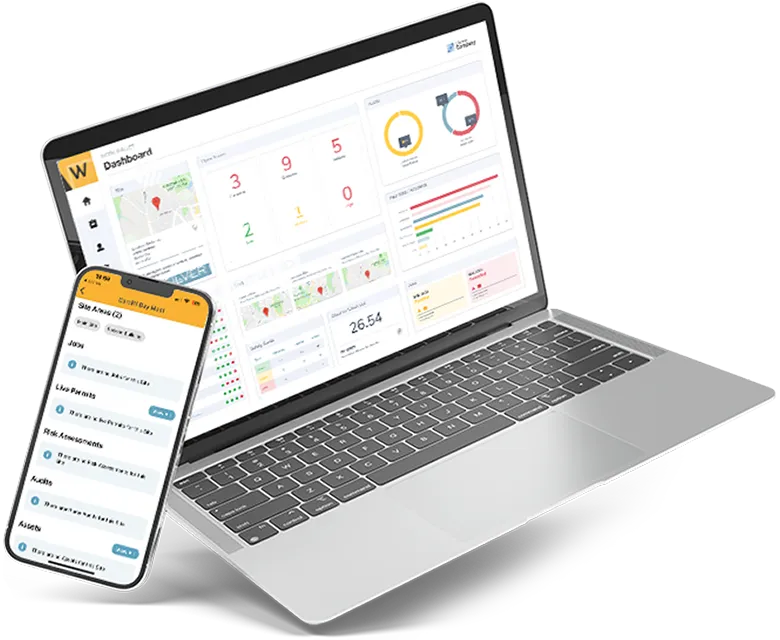
Digital POWRA forms – completed on a mobile device and submitted to a central safety management system – improve completion rates and create an automatically timestamped audit trail. Work Wallet’s Risk Assessments module supports mobile POWRA completion, with the record linked to the worker’s profile and accessible to supervisors in real time.
Is a POWRA a legal requirement?
A POWRA is not explicitly required by name in UK health and safety legislation. However, the Management of Health and Safety at Work Regulations 1999 require employers to make suitable and sufficient risk assessments and to implement appropriate control measures. For tasks where site conditions are variable or workers operate unsupervised, a point of work risk assessment process is one of the most effective ways to demonstrate that the requirement for suitable and sufficient assessment is being met.
In sectors such as utilities, oil and gas and construction, POWRA or an equivalent (sometimes called a ‘dynamic risk assessment’ or ‘last minute risk assessment’) is standard practice and may be contractually required by principal contractors or clients.
Frequently asked questions about POWRAs
What is a POWRA?
A POWRA (point of work risk assessment) is a brief on-the-spot safety check completed by the worker immediately before starting a task. It supplements the background risk assessment by checking that actual site conditions match the assumptions made in advance and identifying any new hazards.
When do you need a point of work risk assessment?
A POWRA is most commonly required for lone workers, field-based workers and anyone carrying out tasks where site conditions are variable or unpredictable. Some employers mandate POWRAs for all field tasks; others apply them based on a defined risk threshold.
Is a POWRA a legal requirement in the UK?
Not by name. However, UK H&S law requires suitable and sufficient risk assessment, and for variable or unsupervised work environments, a POWRA process is a standard and defensible way to meet that requirement.
What is the difference between a POWRA and a dynamic risk assessment?
The terms are often used interchangeably. Some organisations use ‘dynamic risk assessment’ to describe a more continuous, real-time assessment process that applies throughout a task, while ‘POWRA’ refers specifically to the structured check completed before work begins. In practice, the distinction is less important than having a consistent, documented process in place.
Making the POWRA habit stick
The most common failure mode for point of work risk assessment programmes is that workers complete the form without genuinely assessing the conditions – they tick boxes and move on. The organisations that get real value from POWRAs treat them as a behavioural intervention, not a paperwork requirement. Supervisors review POWRA records, workers are trained in the ‘stop, look, assess, manage’ approach, and near-miss findings from POWRAs feed back into the background risk assessment process. Digital completion via Work Wallet’s mobile app supports this by making the process accessible, reducing the time burden and ensuring records reach supervisors automatically.
Get Started
Join the 10,000+ companies that grow with Work Wallet every day - trusted to simplify operations, boost safety, and keep teams connected.